The town and its name
The Royal Buddha Image behind the name
Why Luang Prabang is named for a Buddha statue, the Phra Bang: its story, the Lan Xang kings, the Royal Palace and the town's UNESCO World Heritage listing.
Book your seat ↗Quick answer
Luang Prabang means Royal Buddha Image. The name comes from the Phra Bang, a statue that symbolises Lao sovereignty, given in 1359 to Fa Ngum, the first king of Lan Xang. The town became a UNESCO World Heritage Site in 1995, and the Phra Bang is now kept at Haw Pha Bang in the Royal Palace grounds. A Buddhist stage show fits naturally in such a place.
A name that means a statue
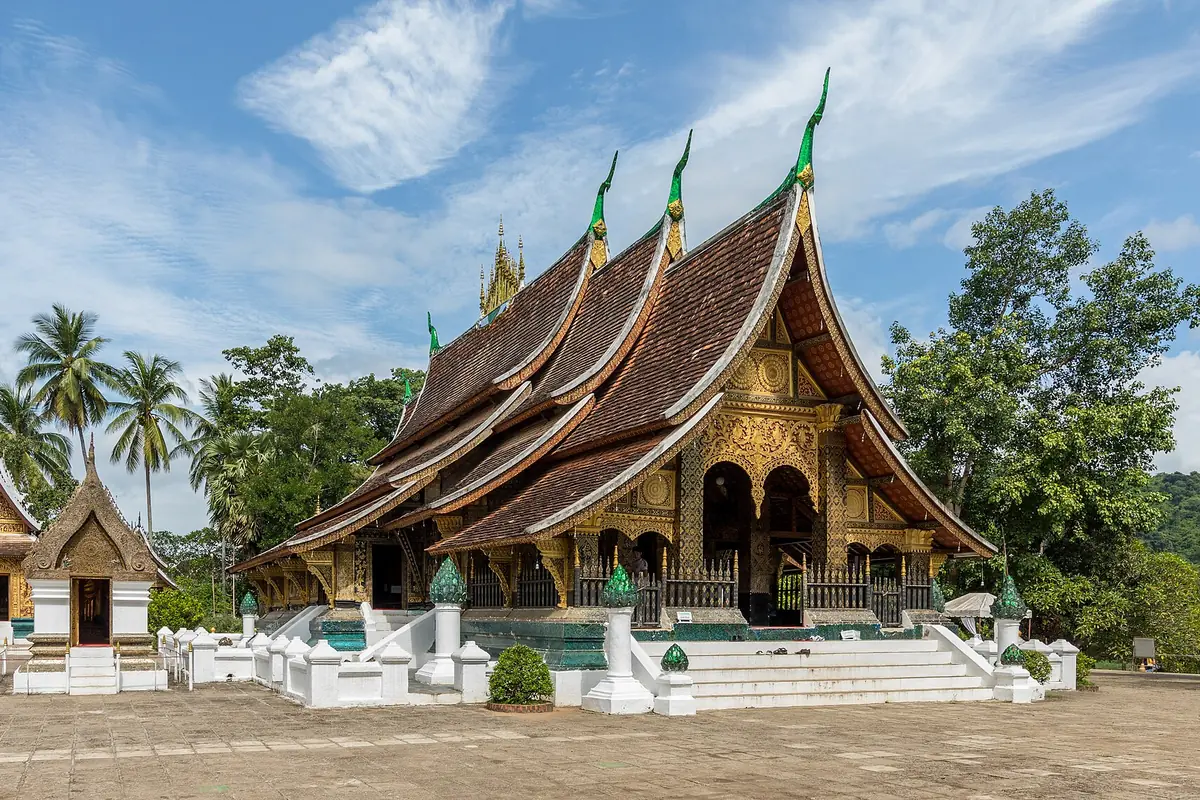
Luang Prabang, historically known as Xieng Thong, takes its name, meaning Royal Buddha Image, from the Phra Bang. Wikipedia describes the statue as a symbol of Lao sovereignty. When Xieng Dong Xieng Thong became the capital of the Lan Xang kingdom in 1353, the town already held an old royal centre, and the capital's name was changed to Luangphabang after the Buddha image. Lan Xang means Land of a Million Elephants, the name of the kingdom that Fa Ngum founded.
What the Phra Bang is
The Phra Bang is a statue of the Buddha, 83 centimetres tall and cast from thong, an alloy of bronze, gold and silver. Local lore holds that it was cast in Ceylon, now Sri Lanka, sometime between the first and ninth century, though the statue's features suggest a much later Khmer origin. It is a small image with a large role: the town and its kingdom were named for it. The first Lan Xang king, Fa Ngum, reigned from 1353 to 1373, and the gift of the statue came in the middle of his reign.
A gift to a king
In 1359 the Khmer king from Angkor gave the Phra Bang to his son-in-law Fa Ngum, the first Lan Xang monarch, to provide Buddhist legitimacy to his rule and, by extension, to the sovereignty of Laos. It was used to spread Theravada Buddhism in the kingdom. Theravada became the state religion when Fa Ngum founded Lan Xang, and it remains the largest religion in Laos today.
From capital to royal seat
In 1707 Lan Xang fell apart in a dynastic struggle, and Luang Prabang became the capital of the Kingdom of Luang Phrabang. When France annexed Laos, the French recognised Luang Prabang as the royal residence of Laos, and when Laos became independent the king of Luang Prabang, Sisavang Vong, became head of state. The Royal Palace was built in 1904 for him and his family, and it became a national museum after the monarchy fell in 1975.
Where the statue is kept
In 2013 the Phra Bang was moved to Haw Pha Bang, on the Royal Palace grounds. The Royal Palace combines traditional Lao motifs with French Beaux-Arts styles, a reminder of the colonial years, since Laos was a French protectorate from 1893 to 1953. Each year the statue is taken in procession to Wat Mai, where laypeople ritually bathe it during the new year festivities, which fall in mid-April.
A protected town
Luang Prabang was designated a UNESCO World Heritage Site in 1995. The city is recognised for blending Lao architecture, European colonial buildings and over 30 Buddhist temples. The protected area covers 33 of its 58 villages, where daily rituals such as the morning alms-giving ceremony continue. The show, the temples and the alms round all belong to the same living tradition. Wat Xieng Thong, built in 1559 and 1560, remained a royal temple where kings were crowned, and Luang Prabang remained a royal capital until 1975.
Where the show comes in
Buddha's Light is a stage show of dance, music, drama, light and imagery on Buddhist teachings, produced by the Luang Prabang International Theatre. A town named for a Buddha statue and still full of temples is the natural place for it. The booking guide covers the tickets and the seating areas, and the story guide explains the lotus, the sacred tree and karma that the show stages.
Read next: Buddha's Light show: tickets and areas
Frequently asked questions
What does Luang Prabang mean?
Royal Buddha Image. The name comes from the Phra Bang, a statue symbolising Lao sovereignty.
When did Luang Prabang become a World Heritage Site?
It was designated a UNESCO World Heritage Site in 1995.
Where is the Phra Bang kept today?
At Haw Pha Bang, on the Royal Palace grounds, since 2013.
Sources